Statcounter

Sunday, 28 September 2014

Cockfosters

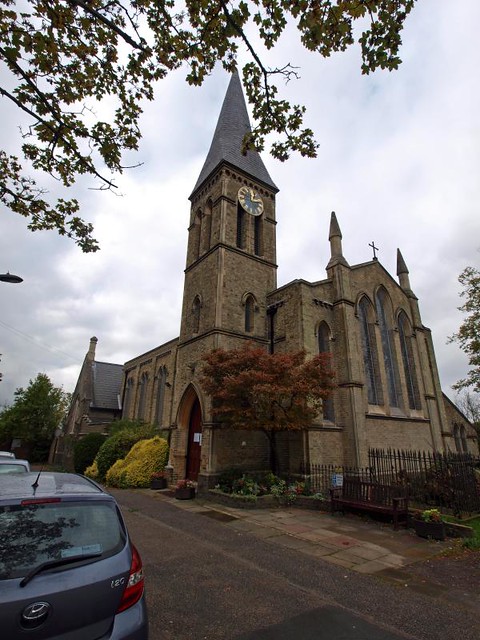
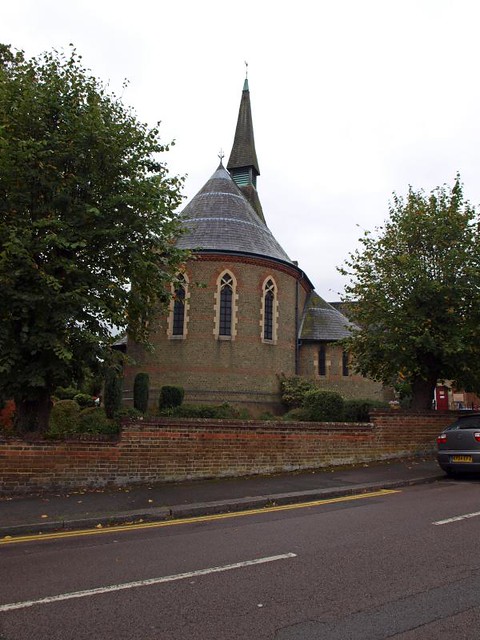
Christ Church, LNK, dire.

COCKFOSTERS: CHRIST CHURCH, 1839, by H. E. Kendall. Still the London stock brick and the lancet windows of the Commissioners’ churches, but no longer symmetrical. The tower stands on the S side just E of the W gable. N aisle added by Sir A. Blomfield, 1898.

 Christ Church (2)  

Mee missed it.

East Barnet

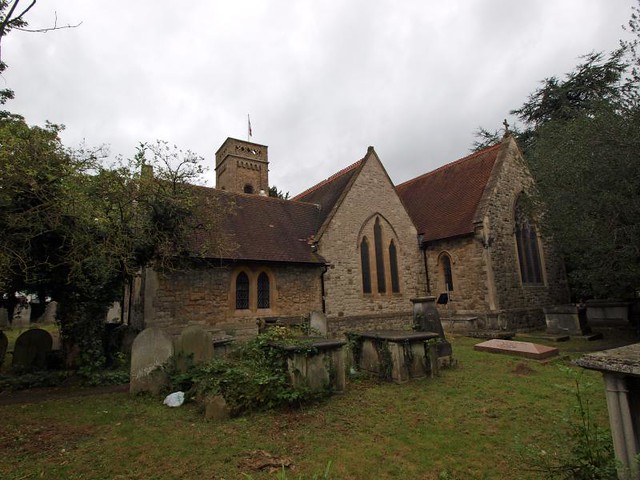
St Mary the Virgin, LNK, should be a stonker but is sadly the ugliest church in Herts. A Norman nave has been subsumed by a ghastly Victorian east chapel and chancel, as for the west tower it can only be described as a water tower and that's being polite.

I was looking forward to this, having, unusually, done some research and was seriously disappointed although the churchyard was interesting.

ST MARY, Church Hill. Nave walls and three small windows in the N wall, Norman. The rest C19. Tower of  yellow brick in a Neo-Norman style, aisle 1868, chancel 1880. - PLATE. Cup of 1636. - Fine graveyard, with old cedar tree S of the church tower. In the graveyard MONUMENT to John Sharpe d. 1756, large urn on big base under a heavy arched baldacchino.

St Mary the Virgin (7)

Eastwards of the London road are East Barnet and Friern Barnet; in both places the chief building of interest is the church. East Barnet is dedicated to Our Lady and is the mother church to which St John’s at Chipping Barnet was once a chapel of ease. The nave walls and three small windows in the north wall are all that remains of the Norman church  - the rest is late 19th century and the most remarkable thing about the church is its, commanding position, for it looks out from the top of Church Hill across Pymmes Brook. A number of famous men are buried at East Barnet. Sir George Prevost was Governor General of Canada in 1812 during the last war between America and England. Of Swiss descent, he had opposed France on England’s behalf in the West Indies and had been rewarded with governorships there, but his appointment in Canada did not go well, for he intervened in military operations and was summoned to London for court martial but died, broken with anxiety, before the trial could be held. His father, General George Prevost, is buried beside him.

Another father and son are here too - Daniel Beaufort who helped to found the Royal Irish Academy and who prepared a map of Ireland, and Admiral Sir Francis Beaufort, who drew up the table of winds still in use today and still known as the Beaufort Scale. Another benefactor of seamen lies here - John Hadley (1682-1744), son of a wealthy Londoner who was elected a Fellow of the Royal Society at the age of 35 and who produced the first reflecting telescope powerful enough to study the stars, and the reflecting quadrant which is still called by his name.

Near to the church in Park Road is the Abbey Arts Centre and Museum, where a collection of far eastern and primitive art is housed in a rebuilt 13th century tithe-barn which stands in an attractive garden with a well. The collection is open to the public on Saturday afternoons or by appointment. A visitor to the neighbourhood might well go on to admire Monkfrith Avenue Infants School, an outstandingly good example of modern architecture.

Lyonsdown

Holy Trinity, LNK, isn't mentioned by Mee or Pevsner but is a dreary pseudo Norman Victorian build entirely lacking merit - frankly it's the zit you wake up to on the morning of your wedding.

Since there's no Pevsner I am going to replace him with a rant about extreme, nay cultish, far right evangelical Christians.

Having taken, almost impossible, exteriors I tried the porch door and found it open but the church door was locked, which I was expecting. As I started to leave, however, the internal door was opened a fraction by a young man, and I mean a fraction - all I could see was his head leaning round the door - and the following conversation occurred:

Youth - "What do you want?"

Me - "Would it be possible to have a look around the church and take some photographs?"

Youth pauses for about a second (probably not even that long)and fires back in a tone that is antagonistic, hostile and defensive all at the same time - "No".

Which is fine and I leave. Except it's not. I came across this sort of Nazi Christianity in Plaistow last year and, whilst I'm fully open to the notion that he was a satanist who had broken in to the church and was sacrificing a virgin on the altar beneath an inverted crucifix, I think he was a fully fledged member of the evangelical church (I Googled Lyonsdown when I got home and they're plainly nutters); probably.

Why are the evangelic evangelicals so hostile and defensive whilst spouting their mission? I think that a simple open church policy would serve them far better rather than their simplistic literal interpretation of biblical learning.

Holy Trinity (2)


Saturday, 27 September 2014

Barnet Vale

St Mark, keyholder listed, is a rather nice 1898 unfinished building with a not totally successful 2006 east end 'extension'.

ST MARK, Potter’s Road, 1898, by J. L. Pearson, but not a spectacular example of that excellent architect’s work. Nave only, the E end a temporary structure. Exterior flint with stone dressings, large Perp aisle windows with four-centred heads. The aisle arcades with tall piers; no clerestory.

St Mark (2)

The absence of Mee is explained by my having a 1965 edition of Hertfordshire by which time Barnet had been constituted and a new volume was published, London North of the Thames, which I've bought and will update the relevant pages when it arrives.

Having got the relevant volume Mee doesn't mention Barnet Vale.

Flickr.

Friday, 26 September 2014

Barnet - Christ Church

I wasn't expecting much from this visit to sweep up the remaining north London churches that were once in Herts but two exceeded those expectations.

Christ Church was open - and this seems to be the normal state of affair since they appear to be a thriving low church with numerous community events, clubs and activities along with concerts, a thriving food bank and is a key part of the local community.

I know all this because when I entered the body of the church I encountered the verger and lay verger who, initially, rather suspiciously asked me if they could help (bear in mind I'm a 50 year old conservative church crawler lacking a hoodie). When I asked if I could look around and take photos - I failed to mention interiors rather than people - the verger, after asking why I wanted to, said he'd have to go and check with Management.

The lay verger then explained that because of the toddlers, baby and pre-school clubs everyone needed to be CRB'd, then gave me a detailed history of the church followed up with a mild, but fervent, critique of Anglican Catholicism - all bells and smells etc.

The verger returned with the verdict...no, I couldn't but if I emailed so and so I could arrange a time to do so, internal mutterings ensued but I was stupid in not pointing out that in the body of the church I wasn't in any danger of broaching decency.

Having been taken under the lay verger's wing I was shown, and told about, all parts of the complex but not around the church.

Will I bother to email for an appointment - I think not; although it looked like it had some good glass which is a shame to miss.

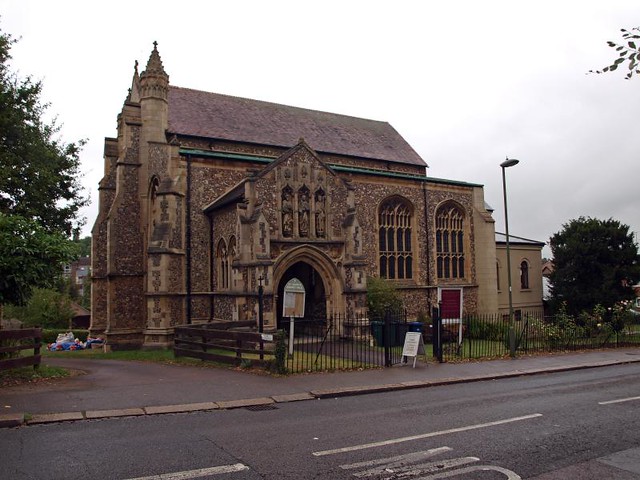
CHRIST CHURCH, New Road. Flint with stone dressings, 1845-52, by G. G. Scott. N aisle 1855.

Christ Church (2)

Flickr.

Wednesday, 24 September 2014

Monken Hadley

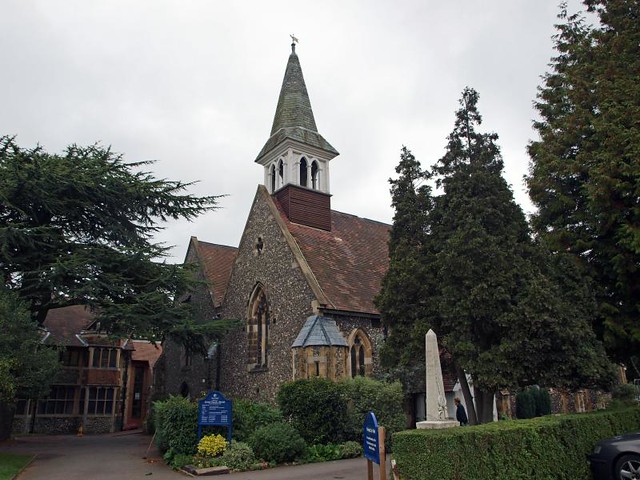
St Mary the Virgin, open, is one of the darkest churches I've visited surrounded as it is by trees on all but the west side. It also contains more, for a church this size (fairly modest), monuments than I think I've come across in other comparable buildings. As you'd expect it's received a heavy handed makeover but despite that this was my church of the day.

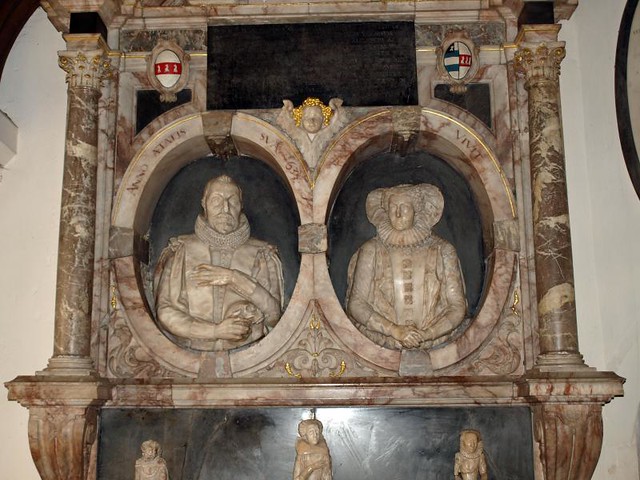
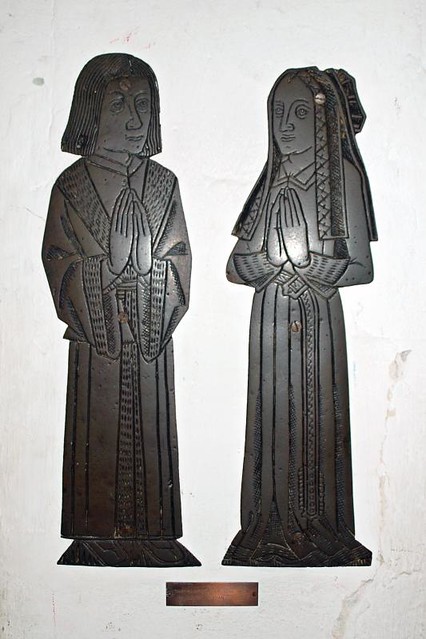
ST MARY. Built probably in 1494, the date appearing in an inscription on the W tower. Flint and iron-stone with white stone dressings. W tower with diagonal buttresses, battlements and higher SW turret. C18 copper BEACON on top, a great rarity. Nave and aisles of two bays; the tower opens in a further bay into the aisles. In addition chancel aisles of one bay. Their arches have the simplest mouldings (concave double-chamfers). The nave piers have capitals only towards the arches, not towards the nave. The arches are four-centred. Squints from both chancel chapels to the chancel. - STAINED GLASS. E window by Warrington, 1846 (signed); S transept E window by Wailes; other contemporary glass. - PLATE. An unusually fine collection. Cup, 1562; Standing Cup and Cover, 1586; Flagon, 1609, of coffee-pot shape; Cup and Obelisk Cover, 1610; another, 1615, especially handsomely decorated; Paten, 1618. - MONUMENTS. Unusual number of small brasses: Lady, C15 (in front of the altar); two ladies (S transept E wall); man and woman, C16 (chancel S wall); woman in demi-profile, c. 1504 (S transept W wall); William Turnour d. 1500 and wife and children (S aisle). - In addition the following later monuments: Sir Roger Wilbraham d. 1616, by Nicholas Stone, epitaph with two busts of outstanding quality in oval niches, the attitudes of exquisite Mannerism. - Alice Stamford and her son, 1626, epitaph with painted portrait of the son, and painted decoration. - Elizabeth Davies d. 1678, epitaph without figures, signed by William Stanton. - Richmond Moore d. 1796, epitaph with female in mournful attitude by a broken column; unsigned.

Roger Wilbraham 1616 (3)

Thomas Goodere 1518 (1)

PUSH self closing door (1)

Today Hadley Green is one of the prettiest pieces of Georgian development to be found near London. Among the 17th and 18th century houses that border it, are the Wilbraham Almshouses, red-brick cottages built in 1612, and a white house, now marked by a blue plaque, where the missionary and traveller David Livingstone stayed in 1857 and wrote his Missionary Travels and Researches in South Africa before returning there in 1858.

On the corner of the Green, screened by trees, is the parish church of St Mary the Virgin. A church existed in the 12th century, but the present building was erected in 1494 - the date is over the west door, a curious half-eight being used to represent a four -of flint and ironstone with white stone dressings. On top of the tower is a copper beacon or cresset, set up not as an Armada warning but during the 18th century, possibly to celebrate the recovery of George III from his illness, and last lit in rejoicing at the Coronation of Queen Elizabeth II (1953).

Inside are a nave, two aisles, a chancel, and two side chapels, dedicated to St Anne and St Catherine. Squints pierce the buttresses between the chancel and the chapels so that mass could be celebrated simultaneously at all three altars. On the capitals of the pillars is the crest of the Goodyere family - a partridge with an ear of wheat in its beak. It was John Goodyere, the lord of the manor, who, dying in 1504, left money “to the making of [the] first floure of the stepull in the said church of hadlegh as moch as it will cost the making of carpentry”. His memorial, a brass, has disappeared, but his wife can still be seen in her long robe and elaborate headdress.

Hadley Church contains one of the finest collections of small brasses to be seen in the county. There is William Turnour (d. 1500) with his wife and four children and, lacking their inscriptions so that they cannot be identified, are two 15th century ladies and a 16th century man and his wife. In addition to the brasses there is a fine monument by the sculptor Nicholas Stone to Sir Roger and Lady Wilbraham who endowed the almshouses on the Green. Sir Roger died in 1616, having been Solicitor General of Ireland. His monument, which cost £50, shows busts of himself and Lady Wilbraham while underneath kneel three pretty daughters with long hair. In the corner of the chancel is another monument to Henry Carew (d. 1620) and his mother, Lady Alice Stamford (d. 1573); his family became lords of the manor after the Abbot of Walden in Essex had been forced to surrender the ownership at the Reformation.

St Mary’s also possesses an exceptionally fine collection of 16th and early 17th century communion plate - a silver gilt flagon, patten and cups - so valuable and so large that a good part of it is on loan to the British Museum.

Beyond the church are 200 acres of Hadley Common which was originally a part of Enfield Chase, the King’s own hunting ground.

Chipping Barnet

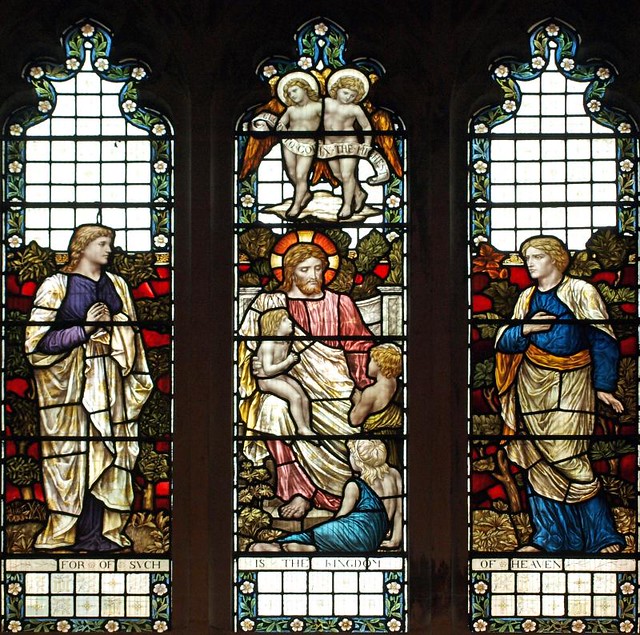
St John the Baptist, open, is essentially a Victorian building incorporating the old medieval church by William Butterfield but it's one of the better ones. Inside are some good Henry Holiday windows and a notable range of furnishings. Having said that it's slightly on the crisp side.

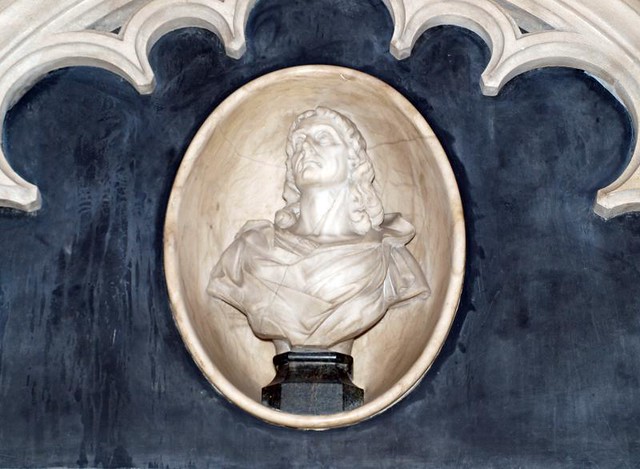
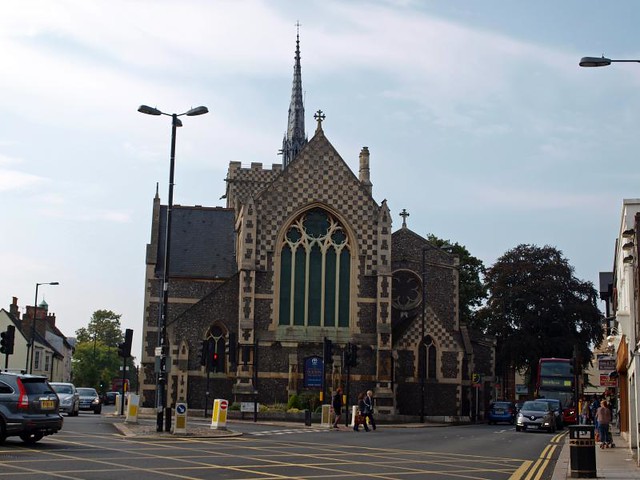
ST JOHN THE BAPTIST. The church points with its E end towards the High Street which comes up the hill from London. To its l. and r. the main roads fork to Watford and to St Albans and Hatfield. The architecture of the church, which is largely Victorian, makes the most of this position, more than the medieval church had done. This was built at the expense of John Beauchamp who died in 1453.* When William Butterfield was commissioned in 1875 to enlarge the old building, he decided to keep the medieval nave and N aisle and to add to it a new higher nave with its own aisle to the S. He also removed the old chancel and tower. So the present church seems to have two naves and two aisles. From the N you see a low aisle and a nave with a clerestory of three-light windows. These clerestory Windows on the S side look into Butterfield’s nave. His own clerestory has somewhat perverse alternating three-light and circular cinquefoil windows. The old church was of flint with sparing stone dressings; Butterfield’s has plenty of stone-bands and chequerwork to enrich the rhythm of the flint work. His W tower is most impressive, big and broad, a beacon when you come up from London, and a dominant accent for the town. Inside, the mid C15 church has an arcade with piers with four attached shafts, four hollows in the diagonals, and complex mouldings in the two-centred arches. Butterfield’s piers and arches are much more robust. - STAINED GLASS. N and S windows of the aisles, good Arts and Crafts style of the 1880s. - PLATE. Small Cup, 1679; Cup and Paten, 1706. - MONUMENTS. Thomas Ravenscroft d. 1630, excellent recumbent alabaster effigy under canopy. The details of the canopy an interesting example of Gothic Survival: cusped arches, rib-vault, quatrefoil frieze of the top cornice. - James Ravenscroft d. 1680 and his wife d. 1689, two fine small marble busts in an altered, Neo-Gothic surround.

* See the inscription in the spandrel of one of the arcade arches.
St John the Baptist (4)

Henry Holiday N aisle 1887 (3)

James Ravenscroft 1680 (2)

The London Borough of Barnet is a combination of the former boroughs of Hendon and Finchley, and the former urban districts of Barnet, East Barnet, and Friern Barnet. It includes the villages of Totteridge, Monken Hadley, Mill Hill, and Edgware. It lies to the north-north-east of the Greater London area, with high ground at Barnet, Mill Hill, and Hendon, and is watered by the Dollis Brook, the Mutton Brook, and the Brent. The Borough has a population of approximately 316,000 and covers an area of 22, 123 acres (35 square miles).

The Borough of Barnet takes its name from Chipping (or High) Barnet which lies to the north. Until 1965, Barnet with Totteridge and Monken Hadley lay within the county of Hertfordshire. The origins of Chipping Barnet are told in its name. The whole area was once a part of the great dense forest that covered Middlesex and beyond. A path led southward down the steep hill to the Dollis Brook and beside it a little village grew up in a burnt clearing - in Anglo-Saxon bare net, hence Barnet. To that village King John gave in 1199 the right to hold a market, and so Chipping was added to Barnet for it is derived from the Anglo-Saxon ceap, a bargain, as in Cheapside in London. That market became Barnet Horse Fair held in the first week in September, and famous till the First World War for the number and quality of animals which changed hands there. Today there is still a three-day fair, and in 1969 some 300 horses were on view there with plenty of traps, gigs, and chaises for sale as well, besides the more usual swings and roundabouts. The faces of the horse dealers were a study - pure-blooded gypsy or straight out of a Hogarth drawing.

The path through the forest gradually broadened and developed till it became the Great North Road. In coaching days, Barnet was the first stage out from London and its chief inns were the Red Lion, the White Hart, and the Mitre. The first two have been rebuilt but the Mitre remains unaltered, looking as it did in 1660 when General Monk, Cromwell’s former lieutenant, stayed there in his march south to put Charles II on the throne of England.

Today, the approach from London is dominated by the parish church dedicated to St John the Baptist. It is a fine bold building with an impressive west tower and a spire. A church stood here in Norman times but was replaced about 1420 by another built partly at the expense of John Beauchamp, a wealthy maltster of Barnet. In 1875, William Butterfield was called in to enlarge the old church. The exterior he rebuilt, making it more imposing and dressing it in flint with bands of stone and chequerwork, but inside he retained the old nave and the north aisle, adding to them a new longer nave and a south aisle. In one of the spandrels of the old arcade with the clerestory windows above, is a red tablet with yellow letters recording Beauchamp’s work, with the date 1453. The corbels that supported the ancient roof are still in place, though the roof has gone. What remains of the old tower is now part of the new nave and one of the old arches leads into the new tower. On these stones are mason’s marks and set in the thick walls are two niches, one with a grimacing head in its tracery, the other with carved flowers. The mediaeval chancel has become a vestry and its old piscina is set in the east wall; there is another piscina at the end of the mediaeval north aisle. The vestry has a 15th century doorway with the old door still on its hinges, with an ancient ring and a massive lock. St  John’s original font is now in St Stephen’s Church in Bell’s Hill, having been thrown away and then found, after many years, in a garden in Totteridge. The present font has a cover rising nearly 15 feet high, with eight little carved statues.

The 19th century woodwork is particularly interesting and varied. The pulpit is by J. C. Traylen and on it are figures of six missionaries and preachers - Hugh Latimer, John Wesley, Canon Liddon, St Augustine, St Aidan, and St Hugh of Lincoln. The canopy is richly carved and there is more elaborate carving on the choir-stalls, while on 159 pew-ends there are scenes or devices in relief, among them Christ in the Carpenter’s Shop, the Good Samaritan, the Stoning of Stephen, and the Vision of Paul.

The new south aisle leads us into the Ravenscroft Chapel in which Thomas Ravenscroft lies on a huge canopied tomb, a dignified figure in ruff and puff sleeves, with much painted heraldry about him and the heads of three angels. He is declared to have been a man of untarnished integrity, of a happy disposition, exceedingly well known for the greatness of his mind. In the wall above the vestry door is a tablet to his wife, who died in 1611, and

Whom Nature made a lovely modest maid,
And marriage made a virtuous loving wife.


The bust of his son, James Ravenscroft, is on the wall of the chapel, with that of his wife, beautifully carved little portraits set in niches. Both the Ravenscrofts were benefactors to Barnet.

Outside the church is a plain cross, raised as a war memorial and to the west stands Barnet Technical College. The college has a fine new building but the site has a long association with education for here was the Queen Elizabeth Grammar School founded in 1573 for the boys of Barnet. The school flourishes today in modern premises in Queen’s Road, and the old red-brick building with its octagonal stair-turrets and Great Hall is used for staffrooms and student meetings. In the middle of the hall rises a solid oak post that supports the roof and must often have been used as a whipping post.

Just behind the Technical College are the nine acres of Old Court House recreation ground - the new Court House is southwards, down the hill. The little park has been well landscaped and beyond it, off Wood Street, is Wellhouse Road where, among suburban houses, a Wellhouse still marks a spring that Samuel Pepys used to visit for its healthgiving properties. He reached it at seven o’clock on August 11, 1667, after a bitterly cold coach journey, on his way to Hatfield.

Further along Wood Street, there are a number of pretty 18th century houses and cottages, one of which houses a local museum and another a maternity hospital, and beyond are four groups of almshouses. Nearest to the church is Jesus Hospital founded in 1679 by James Ravenscroft for six poor women; the founder’s initials are on the gate-piers which are topped with lions. Beyond them in Union Street, surrounding three sides of a green courtyard and screened from the road by fine iron gates, stand the Leathersellers’ Almshouses. Originally founded in 1544 by James Hasilwood near St Helen’s Bishopsgate in the City of London, they were moved to the purer air of Barnet in 1837, largely at the expense of the Master of the Company, Richard Thornton, and since 1964 have been rebuilt as 19 flats to the design of that fine architect, Louis de Soissons. Nearby are houses for six elderly couples built in 1873 but supported by lands left in 1558 by Eleanor Palmer, and a red-brick group of dwellings for six old ladies founded under the will of John Garrett who died in 1728.

Wood Street leads on to Arkley on the way to St Albans, and there the Gatehouse public house marks the site of a former toll-gate and can be recommended for its hospitality, while to the east of the road, Arkley windmill still stands, now in the grounds of a private house, but opened occasionally to the public in aid of the local church féte.

If we follow the Great North Road which runs to the right of St John’s Church, we pass on our right the Hyde Institute founded in 1888 by Miss Julia Hyde who left £10,000 for the purpose; it is now part of the public library system. A mile along the road, there is a broad green with a grey stone obelisk upon it. The stone, erected in 1740 by Sir Jeremy Sambrook who lived at Gobions near North Mimms, marks the supposed site of the death of the Earl of Warwick at the battle of Barnet fought in a heavy mist before dawn on the morning of Easter Sunday, April 14., 1471. The battle lasted some three or four hours but by ten o’clock news had been brought to London and the bells of the City were ringing out for Edward IV, because Warwick the Kingmaker, who had turned his coat to support Henry VI, was lying dead, with some 1500 men from the two armies beside him, on Hadley Green and the ground beyond, called Deadman’s Bottom to this day. Edward and his men refreshed themselves in Barnet and gave thanks to God, possibly in St John’s Church, and then marched on to London where the gates were opened to him. Henry VI was deposed, paraded through the streets, and murdered on May 21.